
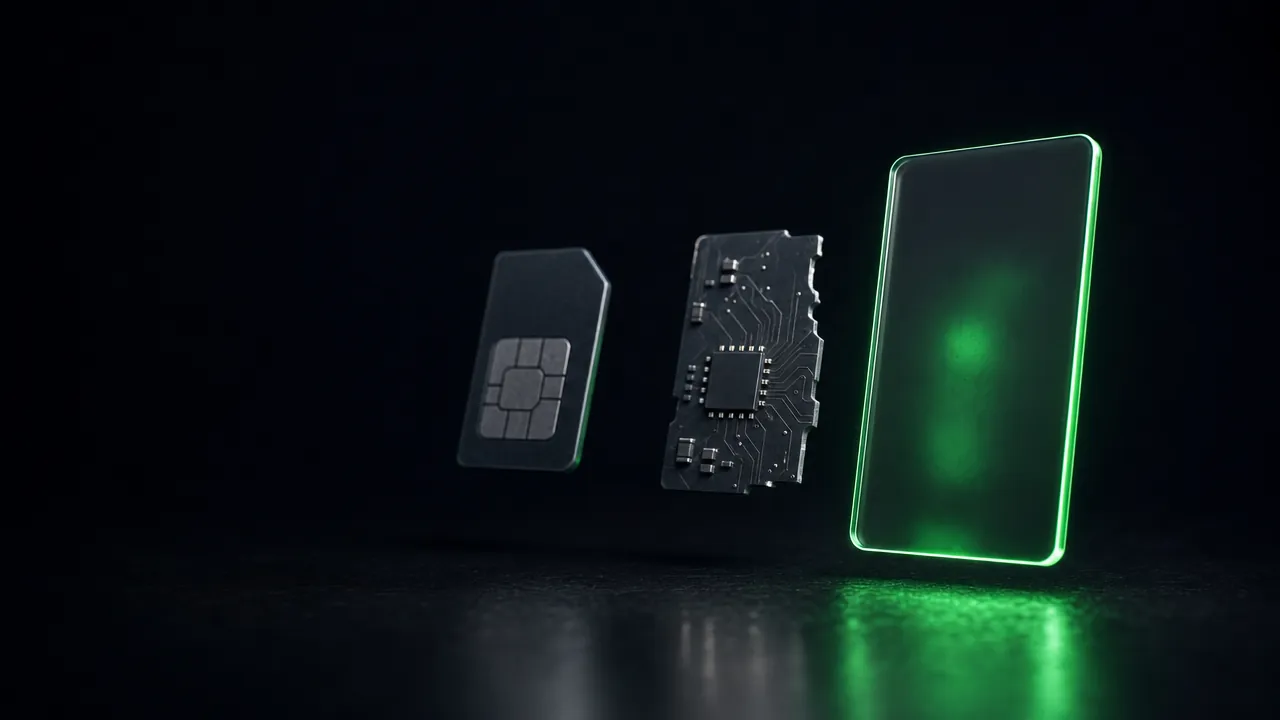
The three things, precisely
- A virtual number is a rented allocation from a carrier, routed to software. No SIM, no hardware, works in a browser. What we sell.
- An eSIM is a real SIM profile downloaded to a phone that supports it. Most travel eSIMs are data only and have no number at all; the ones that do give you a number are ordinary mobile subscriptions with a QR code instead of plastic.
- A burner SIM is a physical prepaid card bought in a shop, put in a phone, thrown away later.
The eSIM misunderstanding. Most travel eSIMs sold as « anonymous » are data-only: they give you internet, not a number, and no SMS will ever arrive on one. Check for a phone number in the product description before buying one to receive codes.
Side by side
| Virtual number | eSIM with a number | Prepaid SIM | |
|---|---|---|---|
| Hidden from the carrier | No — the carrier knows the range is ours | No — registered in most countries | Yes, where cash purchase is still legal |
| Hidden from the service you sign up to | Yes | Yes | Yes |
| Needs a document | No | Usually yes | Depends on the country |
| Needs the right hardware | No, any browser | Yes, a compatible phone | Yes, a phone with a slot |
| Works from abroad | Yes, anywhere | Yes, with roaming cost | Poorly — permanent roaming gets it cut |
| Receives SMS codes | Yes | Yes | Yes |
| Typical cost | From $8.90 a month | Plan price plus device support | Cheap up front, top-ups forever |
| Multiple numbers at once | Yes, as many as you pay for | One or two per phone | One per slot |
| Can be dropped instantly | Yes, one click | Yes | Yes, physically |
| Paid without a card | Yes, crypto | Rarely | Yes, cash |
Which one you actually need
You want services to stop having your real number
Virtual number. It is the cheapest, it takes a minute, it needs no hardware, and you can hold several — one for marketplaces, one for dating, one for the thing you signed up to once. The carrier knowing the range belongs to a provider is irrelevant here: the platform is what you are separating from, and it cannot connect the line to you.
You need the carrier not to know who you are
Prepaid SIM bought with cash, in a country that still allows it, and nothing else will do. This is a real requirement for a small number of people — journalists, people leaving an abusive relationship, activists under pressure. Be clear-eyed about it: a virtual number does not give you this, and we will not pretend otherwise.
You need data abroad
Travel eSIM, which is what they are good at. Keep your normal number for calls and add a virtual line if you also want a local presence in that country.
You need a local business presence in another country
Virtual landline in that country. It takes calls and voicemail, reads as local to customers, and costs about 20% less than mobile. No office and no local company required, though local rules vary.
You want a second number on the same phone
Either a dual-SIM handset with a second physical card, or a virtual number in a browser tab. The virtual one is cheaper and does not need a compatible device — and unlike a second SIM, it does not put both identities in the same handset, which is the thing that makes them correlatable.
What each one leaks
The honest version, since this is the part product pages skip.
A virtual number leaks
- That it is a virtual number, to anyone who checks the range against a public database. Some platforms do.
- The country, to anyone who sees it.
- Nothing about you to the platform — provided you did not pay with a card in your name, which is why we take crypto only.
An eSIM leaks
- Your identity to the carrier in most countries, because the profile was bought with a card and often with a document.
- Your device, permanently. The IMEI ties the profile to the handset, and the handset to everything else on it.
A burner SIM leaks
- Your location, continuously, to the carrier — that is how cell networks work, and it is true of any SIM.
- Your identity, if the phone it goes into has ever held your real SIM. That correlation is trivial and routinely made.
The mistake that undoes a burner. Putting a cash-bought SIM into the phone that already carries your real one. The network sees both on the same device and the separation is gone. A burner needs its own handset to mean anything.
Using more than one
Most people who take this seriously end up with a combination, and it is not complicated:
- Real SIM for family, the bank and emergency calls. Given to almost nobody else.
- One virtual number as the public one — marketplaces, deliveries, forms, anything that will end up in a breach.
- A second virtual number for the accounts that matter, kept off every form. In a broadly accepted country, since these are the ones you cannot lose.
- A burner SIM only if you have a genuine need to be invisible to the carrier, in its own handset.
Holding several virtual lines costs one activation each and then the monthly rate, and they all sit in the same panel with separate inboxes. That is the practical reason this combination is common: it is cheap and it needs no extra hardware.
Questions
Is a virtual number more anonymous than a prepaid SIM?
Not from the carrier — a cash-bought prepaid SIM in a permissive country is stronger there. A virtual number is more anonymous from the services you give it to, because there is no subscriber record anywhere connecting it to you, and no card payment to correlate.
Do travel eSIMs come with a phone number?
Most do not. They are data-only, so no SMS will ever arrive. Some do include a number, and those are ordinary mobile subscriptions with the usual registration requirements in most countries.
Can I use a virtual number on WhatsApp like a SIM?
Yes. WhatsApp verifies by SMS or a call, both of which arrive on our mobile lines, and the account then lives on your device as normal. Watch for occasional re-verification months later — there is a full breakdown in our guide on the major apps.
Which is cheapest over a year?
A prepaid SIM is cheapest if you already live where you bought it and can top it up locally. For anyone else, a virtual line paid yearly is cheaper than keeping a foreign prepaid alive, and it does not die while you are not looking.
Can I move my number between these?
No. Portability requires a subscriber contract in your name, which is exactly what none of these have. Treat each number as belonging to the thing that issued it.
Written by the people who run the service, updated 30 July 2026. If something here is wrong or out of date, tell us — we fix guides faster than we fix code.